
Key takeaways
- Automation failures often come from stale state, wrong symbol mapping, expired credentials, or mismatched risk settings, not from clever strategy flaws.
- The checklist needs to cover both the chart logic and the execution path.
- Verify that strategy settings, alert messages, and position-sizing assumptions still match the current version of the system.
- A major way traders lose edge is assuming yesterday’s configuration is still correct today.
A pre-market checklist for automated traders should verify strategy state, broker state, symbol mapping, risk caps, and failure handling before the market starts moving. The goal is to catch boring problems before they become expensive ones. For active traders, that matters because pre-market checklist usually breaks down when the chart idea and the decision process drift apart. The goal is not to romanticize the concept. The goal is to make it specific enough that a trader can recognize the right environment, define the invalidation point, and explain afterward why the setup was or was not worth taking. Readers want a practical pre-market routine for live automation, not vague advice about preparation. A clean workflow starts by separating the job of the concept from the noise around it. Pre-market checklist should answer a practical question before the trade, during the trade, and after the trade. If the trader cannot state that question clearly, the setup will usually get bent by emotion, late entries, or hindsight once the market gets fast.
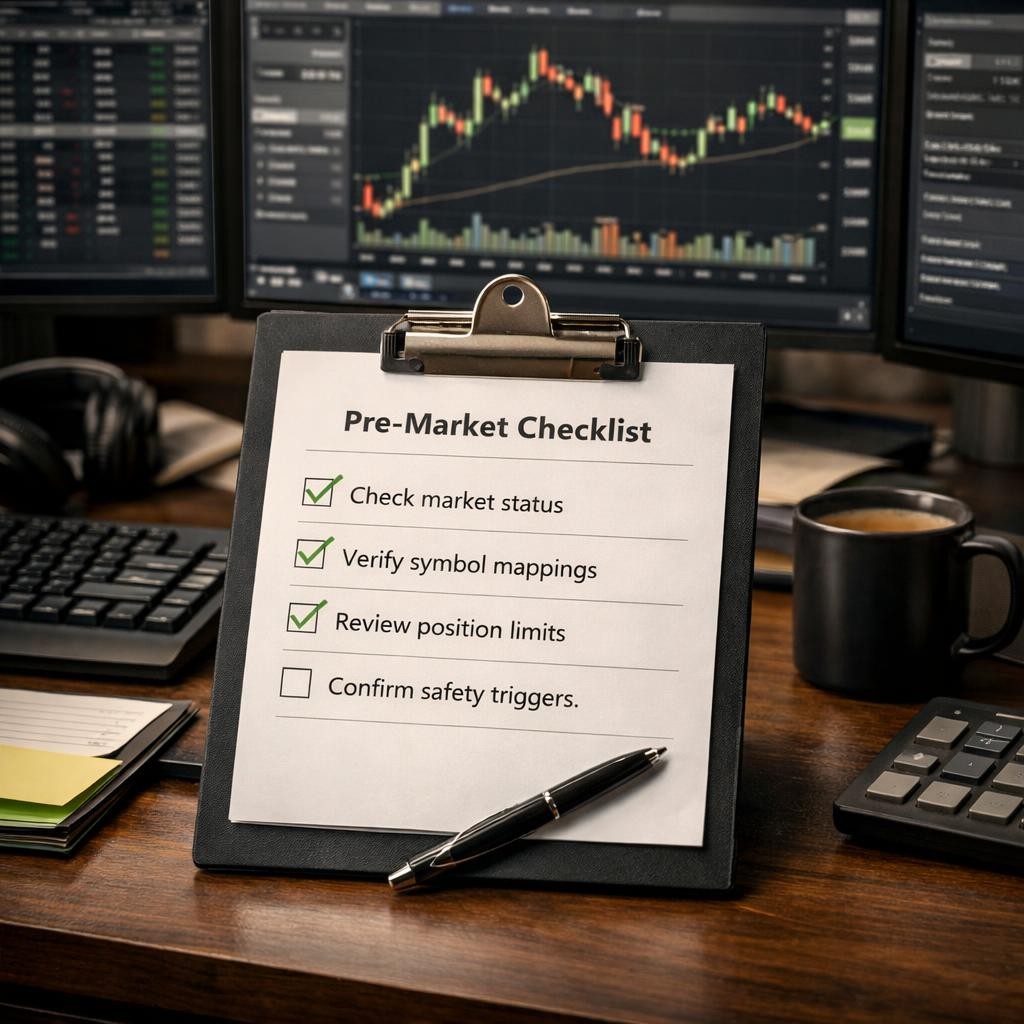
Throughout this guide, the focus stays on the parts that actually move the outcome: checklist, pre-market, and alerts. Those details matter more than slogans because they determine whether the idea survives real execution pressure or collapses into a story that only sounds coherent after the fact.
What pre-market checklist actually means in live trading
In live trading, pre-market checklist should function as a decision aid rather than a decorative label. The concept earns its place when it helps the trader understand location, define what must happen next, and recognize when the premise no longer deserves capital.
Pre-market checklist gets misused when traders treat pre market checklist, automated trading checklist, webhook routing checks, and broker connection checklist as separate ideas instead of linked parts of the same process. A coherent workflow ties those pieces together so the trader knows what the market is saying, what qualifies as confirmation, and what would prove the setup wrong.
Why traders struggle with pre-market checklist
Most traders struggle here because the concept sounds cleaner in hindsight than it feels in a fast market. The tension usually comes from one of two problems: the concept is defined too loosely, or the trader keeps expanding the number of acceptable interpretations once the market starts moving. Either way, the setup stops being a framework and starts becoming a negotiation.
The fix is to tighten the definition until it can survive a fast tape. A strong explanation of pre-market checklist should tell the trader what deserves attention, what should be ignored, and what evidence changes the trade from “interesting” to “actionable.” If the rule only makes sense on a screenshot after the move, it is still too vague.
Core principles that make pre-market checklist useful
The strongest version of this topic is not built on one signal. It is built on a handful of principles that keep the concept honest when the chart is noisy or the workflow is under pressure.
Principle 1
The first thing to understand here is straightforward: Automation failures often come from stale state, wrong symbol mapping, expired credentials, or mismatched risk settings, not from clever strategy flaws. Traders often nod at automation failures often come from stale state and then ignore the operating implication. In practice, pre-market checklist only helps when the trader uses automation failures often come from stale state to reduce uncertainty rather than add another interpretation layer. That is why automation failures often come from stale state has to be visible in checklist, pre-market, and alerts, not only in theory. When the trader reviews how automation failures often come from stale state behaved, the rule should explain what deserved attention, what changed the risk profile, and what should have been ignored once the workflow has to survive real timestamps, real account state, and real execution constraints. The principle becomes genuinely useful when the trader can connect automation failures often come from stale state to a concrete action: wait, engage, reduce size, or stand aside. That connection around automation failures often come from stale state is what turns knowledge into a trading edge instead of a post-trade explanation.
Principle 2
One of the core rules behind pre-market checklist is simple but easy to violate: The checklist needs to cover both the chart logic and the execution path. The market does not reward the trader for knowing the phrase. It rewards the trader for applying the checklist needs to cover both the chart logic and the execution path consistently enough that entries, exits, and skips come from the same logic. A principle earns its place only when it changes the trade management decisions around the checklist needs to cover both the chart logic and. If that idea does not alter location, timing, size, or patience once the workflow has to survive real timestamps, real account state, and real execution constraints, it is probably being treated like a talking point instead of a trading rule. A practical way to audit this principle is to ask whether the checklist needs to cover both the chart logic and would still be visible to another disciplined trader looking at the same session. If the answer around that idea depends on private interpretation, the concept still needs a tighter definition.
Principle 3
The first thing to understand here is straightforward: Pre-market review is the time to find silent failures before the open magnifies them. Traders often nod at pre-market review is the time to find silent failures before and then ignore the operating implication. In practice, pre-market checklist only helps when the trader uses pre-market review is the time to find silent failures before to reduce uncertainty rather than add another interpretation layer. That is why pre-market review is the time to find silent failures before has to be visible in checklist, pre-market, and alerts, not only in theory. When the trader reviews how pre-market review is the time to find silent failures before behaved, the rule should explain what deserved attention, what changed the risk profile, and what should have been ignored once the workflow has to survive real timestamps, real account state, and real execution constraints. The principle becomes genuinely useful when the trader can connect pre-market review is the time to find silent failures before to a concrete action: wait, engage, reduce size, or stand aside. That connection around pre-market review is the time to find silent failures before is what turns knowledge into a trading edge instead of a post-trade explanation.
Principle 4
One of the core rules behind pre-market checklist is simple but easy to violate: The checklist should be short enough to run daily and precise enough to matter. The market does not reward the trader for knowing the phrase. It rewards the trader for applying the checklist should be short enough to run daily and precise enough to matter consistently enough that entries, exits, and skips come from the same logic. A principle earns its place only when it changes the trade management decisions around the checklist should be short enough to run daily and. If that idea does not alter location, timing, size, or patience once the workflow has to survive real timestamps, real account state, and real execution constraints, it is probably being treated like a talking point instead of a trading rule. A practical way to audit this principle is to ask whether the checklist should be short enough to run daily and would still be visible to another disciplined trader looking at the same session. If the answer around that idea depends on private interpretation, the concept still needs a tighter definition.

How to apply pre-market checklist before the trade
Application should begin before entry is even possible. This is where the trader turns the concept into a routine that narrows the trade instead of merely decorating the chart.
Step 1
The process becomes practical at this stage: Verify that strategy settings, alert messages, and position-sizing assumptions still match the current version of the system. That wording matters because it forces the trader to do the work before the trade, when there is still time to define the environment, the trigger, and the invalidation level clearly. This is also where many traders discover whether the topic is actually usable in their own workflow. A strong step narrows the number of acceptable trades, clarifies what the market has to prove next around verify that strategy settings, and reduces the temptation to keep bargaining with the chart after the premise has weakened. The value of the step shows up in the skip decisions too. If verify that strategy settings is missing, weak, or late, the process should make it easier to stay flat instead of turning every near-miss into a rationalized trade.
Step 2
A repeatable process around pre-market checklist usually depends on one concrete behavior: Check the broker connection, account status, tradable symbol map, and any daily loss or max-position guards. Without check the broker connection, the setup stays too dependent on feel, and feel changes quickly once the session starts printing faster than the trader can narrate. Notice what this step does operationally: it turns check the broker connection into a filter. That filter should help the trader say yes faster to the right setup, no faster to the wrong one, and stay flat when the chart is technically active but structurally unhelpful. In practice, this means the trader should be able to point to evidence before entry and say why check the broker connection supports the trade now rather than five bars later. That timestamp discipline is what keeps late entries and narrative drift under control.
Step 3
The process becomes practical at this stage: Confirm the behavior of rejects, duplicate alerts, stale positions, and kill-switch controls before the session. That wording matters because it forces the trader to do the work before the trade, when there is still time to define the environment, the trigger, and the invalidation level clearly. This is also where many traders discover whether the topic is actually usable in their own workflow. A strong step narrows the number of acceptable trades, clarifies what the market has to prove next around confirm the behavior of rejects, and reduces the temptation to keep bargaining with the chart after the premise has weakened. The value of the step shows up in the skip decisions too. If confirm the behavior of rejects is missing, weak, or late, the process should make it easier to stay flat instead of turning every near-miss into a rationalized trade.
Example walkthrough: The pre-market checklist for automated traders: what to verify before alerts start routing live
Examples matter because they reveal the order of decisions. The chart may move quickly, but the logic still needs to answer the same sequence of questions every time.
Example step 1
A realistic walkthrough helps because live trading does not arrive as a neat checklist item. Before the session, the trader confirms the broker is connected, the correct account is selected, and the product symbols still map correctly In a real session, that moment forces the trader to connect the concept to location, timing, and the quality of the immediate response instead of relying on a clean hindsight screenshot. The key question is what the trader does next after before the session. Good examples are not about predicting every tick. They are about showing what evidence increases conviction, what evidence invalidates the idea, and how the trader keeps risk aligned with the original premise instead of the hope of a larger move. This is why walkthroughs should end with a decision, not a lecture. After before the session, the trader either has a cleaner trade, a cleaner skip, or a clearer invalidation. All three are useful outcomes when the process is honest.
Example step 2
Consider how this would look in the middle of a real session: The trader checks that the alert payload matches the current stop and target logic after a recent strategy change That example matters because it shows what the trader checks that the alert payload matches the current looks like when the concept is doing actual work instead of living as a definition beside the chart. The value of a walkthrough is that it exposes decision order around the trader checks that the alert payload matches the current. The trader has to decide what matters first, what is only supportive context, and what should cancel the trade. That order is what keeps the concept coherent under real pressure. Examples like this also reveal where patience belongs. If the confirming evidence never arrives after the trader checks that the alert payload matches the current, the trader still learns something valuable: the concept gave location, but it never gave permission.
Example step 3
A realistic walkthrough helps because live trading does not arrive as a neat checklist item. The open begins with less uncertainty because the boring failure points were checked in advance In a real session, that moment forces the trader to connect the concept to location, timing, and the quality of the immediate response instead of relying on a clean hindsight screenshot. The key question is what the trader does next after the open begins with less uncertainty because the boring failure. Good examples are not about predicting every tick. They are about showing what evidence increases conviction, what evidence invalidates the idea, and how the trader keeps risk aligned with the original premise instead of the hope of a larger move. This is why walkthroughs should end with a decision, not a lecture. After the open begins with less uncertainty because the boring failure, the trader either has a cleaner trade, a cleaner skip, or a clearer invalidation. All three are useful outcomes when the process is honest.
Checklist before you trust pre-market checklist live
A checklist is valuable because it interrupts optimism. Before size goes on, the setup should pass a small number of hard gates that protect both the trade idea and the review process.
Checklist item 1
Before a setup deserves real risk, this checkpoint needs an honest answer: Verify account, credentials, and broker connection. Checklist items like verify account matter because they prevent the trader from treating confidence as proof. The trade is not ready simply because the chart looks familiar. When traders skip verify account, they usually compensate by adding interpretation later. A proper checklist does the opposite. It removes negotiation around verify account and keeps the process narrow enough that the post-trade review can tell whether the setup really followed the playbook. A checklist is not there to make the process feel restrictive. It is there to make sure verify account gets answered in the calm part of the decision, before price movement and urgency start rewriting the standard.
Checklist item 2
Use this checkpoint as a hard gate, not as a suggestion: Confirm symbol mapping and contract details. The point of the checklist is to stop weak trades around confirm symbol mapping and contract details early, when discipline is cheap, instead of depending on mid-trade willpower to correct a sloppy start. A strong checklist item also creates better review data. If confirm symbol mapping and contract details was fuzzy before entry, the trader should be able to see that on the journal page afterward rather than pretending the weak decision came from bad luck alone. Checklist discipline around confirm symbol mapping and contract details matters because it protects the trader from acting on familiarity alone. When confirm symbol mapping and contract details is answered honestly, the trade either earns risk more clearly or gets filtered out before emotion has a chance to dress it up.
Checklist item 3
Before a setup deserves real risk, this checkpoint needs an honest answer: Check strategy version, alert message, and risk settings. Checklist items like check strategy version matter because they prevent the trader from treating confidence as proof. The trade is not ready simply because the chart looks familiar. When traders skip check strategy version, they usually compensate by adding interpretation later. A proper checklist does the opposite. It removes negotiation around check strategy version and keeps the process narrow enough that the post-trade review can tell whether the setup really followed the playbook. A checklist is not there to make the process feel restrictive. It is there to make sure check strategy version gets answered in the calm part of the decision, before price movement and urgency start rewriting the standard.
Checklist item 4
Use this checkpoint as a hard gate, not as a suggestion: Review kill switch and pause behavior. The point of the checklist is to stop weak trades around review kill switch and pause behavior early, when discipline is cheap, instead of depending on mid-trade willpower to correct a sloppy start. A strong checklist item also creates better review data. If review kill switch and pause behavior was fuzzy before entry, the trader should be able to see that on the journal page afterward rather than pretending the weak decision came from bad luck alone. Checklist discipline around review kill switch and pause behavior matters because it protects the trader from acting on familiarity alone. When review kill switch and pause behavior is answered honestly, the trade either earns risk more clearly or gets filtered out before emotion has a chance to dress it up.
Checklist item 5
Before a setup deserves real risk, this checkpoint needs an honest answer: Scan recent logs for silent failures or warnings. Checklist items like scan recent logs for silent failures or warnings matter because they prevent the trader from treating confidence as proof. The trade is not ready simply because the chart looks familiar. When traders skip scan recent logs for silent failures or warnings, they usually compensate by adding interpretation later. A proper checklist does the opposite. It removes negotiation around scan recent logs for silent failures or warnings and keeps the process narrow enough that the post-trade review can tell whether the setup really followed the playbook. A checklist is not there to make the process feel restrictive. It is there to make sure scan recent logs for silent failures or warnings gets answered in the calm part of the decision, before price movement and urgency start rewriting the standard.
Common mistakes and failure modes
Most losses around this topic do not come from not knowing the vocabulary. They come from letting the process bend under pressure. These failure modes are where the edge usually leaks out.
Failure mode 1
A recurring failure mode is easy to recognize once you know what to look for: Assuming yesterday’s configuration is still correct today. The reason it persists is that it often produces a plausible explanation after the trade, even though it was already degrading the decision before the order was ever sent. The fix is usually less dramatic than traders expect. It means tightening the rule around assuming yesterday’s configuration is still correct today, reducing the number of acceptable exceptions, and making the trade earn its way into the plan instead of being waved through because the idea sounded close enough. Most expensive habits survive because they are tolerated in “almost good enough” form. Naming exactly how assuming yesterday’s configuration is still correct today distorts the setup makes it much easier to remove that habit from the playbook.
Failure mode 2
One of the more expensive mistakes around pre-market checklist is Skipping symbol-map or contract-roll checks. Traders usually notice the loss or the frustration first, but the real damage starts earlier, when the process quietly stops respecting the original thesis. This is where review matters. If skipping symbol-map or contract-roll checks keeps producing the same mistake, the answer is not another motivational note. The answer is to rewrite the process so the weak assumption becomes visible before capital is exposed. A good correction usually starts with one question: what should have blocked this trade earlier? When the trader can answer that clearly, the mistake stops being a vague frustration and becomes a concrete improvement item.
Failure mode 3
A recurring failure mode is easy to recognize once you know what to look for: Ignoring the automation logs until something goes wrong during the open. The reason it persists is that it often produces a plausible explanation after the trade, even though it was already degrading the decision before the order was ever sent. The fix is usually less dramatic than traders expect. It means tightening the rule around ignoring the automation logs until something goes wrong during the, reducing the number of acceptable exceptions, and making the trade earn its way into the plan instead of being waved through because the idea sounded close enough. Most expensive habits survive because they are tolerated in “almost good enough” form. Naming exactly how ignoring the automation logs until something goes wrong during the distorts the setup makes it much easier to remove that habit from the playbook.
Review questions after the session
The review loop is where the concept becomes durable. Good review work is not about defending the trade. It is about checking whether the decision chain behaved the way the playbook said it should.
Review question 1
After the session, this is the right question to ask: Which pre-market check would have prevented today’s issue. Review questions matter because they turn the topic back into observable behavior. A good answer should point to evidence on the chart, in the journal, or in the execution record. If the answer to which pre-market check would have prevented today’s issue is vague, the next revision should simplify the process rather than add another clever rule. Good review work reduces ambiguity. It does not reward the trader for inventing better explanations after the fact. This is how the concept compounds over time. Each honest answer to which pre-market check would have prevented today’s issue makes the process a little clearer, which means future trades depend less on memory and more on a standard that can actually be repeated.
Review question 2
The review loop becomes useful when it asks something concrete: Did the checklist catch a configuration drift before the market opened. That question keeps the trader from grading the result alone and pushes the review back toward decision quality, risk discipline, and whether the plan stayed intact under pressure. This is also where patterns start to show up. If did the checklist catch a configuration drift before the market keeps producing the same weak answer across multiple sessions, the trader has found a process gap. That is the point where the playbook should change, not merely the self-talk. Strong reviews usually end with one actionable adjustment. If did the checklist catch a configuration drift before the market exposed a weak assumption, the follow-up should change the checklist, the trade filter, or the sizing rule before the next session begins.
Review question 3
After the session, this is the right question to ask: Is the checklist still short enough to be used consistently. Review questions matter because they turn the topic back into observable behavior. A good answer should point to evidence on the chart, in the journal, or in the execution record. If the answer to is the checklist still short enough to be used consistently is vague, the next revision should simplify the process rather than add another clever rule. Good review work reduces ambiguity. It does not reward the trader for inventing better explanations after the fact. This is how the concept compounds over time. Each honest answer to is the checklist still short enough to be used consistently makes the process a little clearer, which means future trades depend less on memory and more on a standard that can actually be repeated.
When pre-market checklist has less edge than traders think
Every useful concept has environments where it becomes weaker. Pre-market checklist tends to lose value when the trader forces it onto a market condition it was never meant to solve, or when the surrounding context no longer supports the original premise. Thin trade, messy rotations, late entries, and unclear invalidation all make the idea look simpler on paper than it feels in execution.
That does not mean the concept is broken. It means the trader has to know when it is functioning as primary evidence and when it is only supportive context. Many weak trades happen because the market has already moved too far, the location is no longer attractive, or the trader is using the concept as a reason to participate rather than a reason to filter.
This section is especially important for active traders because discipline is not just about taking good trades. It is also about passing on setups that technically fit the label but no longer offer clean location, clean risk, or clean follow-through. The concept stays valuable when the trader can say no without resentment.
Turning pre-market checklist into a repeatable playbook
A repeatable playbook starts with the simplest version of the idea that still captures the edge. The trader should be able to describe the setup, the no-trade conditions, the invalidation level, and the review standard in language that another disciplined operator could understand without being asked to guess what “looks good” means that day.
From there, improvement comes from review, not from piling on exceptions. If the same problem keeps appearing, tighten the rule or remove the condition that creates confusion. Good playbooks get clearer as they mature. They do not become more impressive by becoming harder to explain.
That is the real value of learning pre-market checklist well. The payoff is not only a better chart read or a cleaner entry. The payoff is a process that holds together from the opening plan to the post-trade review, which is what gives the concept staying power across many sessions rather than one memorable screenshot.
Bottom line
The pre-market checklist for automated traders: what to verify before alerts start routing live should help the trader make better decisions, not tell a better story after the move. When the concept is defined clearly, applied in the right environment, pressure-tested with examples, and reviewed honestly, it becomes much more than a buzzword. It becomes a practical part of the trading process.
That is the standard worth aiming for. Understand what the concept measures, respect the conditions that make it useful, and keep the review loop tight enough that weak assumptions are exposed early. Traders who do that usually get more value from the topic because they are learning how to think with it, not just how to name it.
Frequently asked questions
What is the most important pre-market automation check?
Usually it is verifying that the strategy state, broker state, and symbol mapping all agree before orders can route live.
Why do automated traders need a checklist every day?
Because small configuration changes, stale positions, or connection issues can create live risk even when nothing looks obviously broken.
Should the checklist be long and exhaustive?
It should be thorough enough to catch real risk but short enough to run consistently before every session.
Newer
Post-trade review checklist: the five questions that expose weak assumptions before they repeat
Older